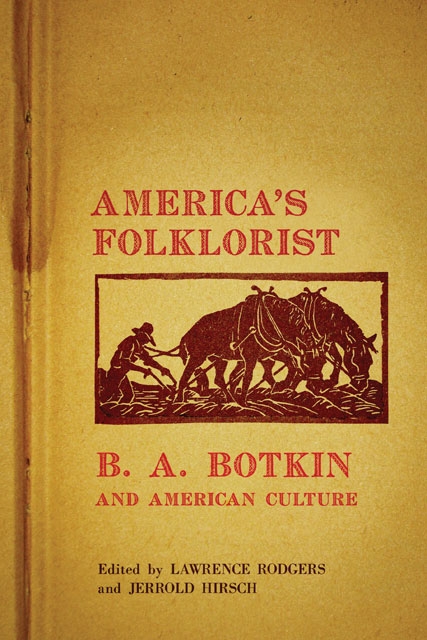
 Jerry Hirsch has published the edited volume (with Lawrence Rodgers) America’s Folklorist: B. A. Botkin and American Culture (Norman: University of Oklahoma Press, 2010).
Folklorist, writer, editor, regionalist, cultural activist—Benjamin Albert Botkin (1901–1975) was an American intellectual who made a mark on the twentieth century, even though most people may be unaware of it. This book, the first to reevaluate the legacy of Botkin in the history of American culture, celebrates his centenary through a collection of writings that assess his influence on scholarship and the American scene.
Through his work with the Federal Writers’ Project during the New Deal, the Writers’ Unit of the Library of Congress Project, and the Archive of American Folksong, Botkin did more to collect and disseminate the nation’s folk-cultural heritage than any other individual in the twentieth century. This volume focuses on Botkin’s eclectic but interrelated concerns, work, and vision and offers a detailed sense of his life, milieu, influences, and long-term contributions.
Just as Botkin boldly cut across the boundaries between high and low, popular and folk, this book brings together reflections that range from the historical to the philosophical to the disarmingly personal. One group of articles looks at his career and includes the first extended analysis of Botkin’s poetry; another probes the fruitful relationships Botkin had with leading musicologists, composers, poets, and intellectuals of his day. This is also the first book to bring together a collection of Botkin’s best-known writings, giving readers an opportunity to appreciate his wide-ranging mind and clear, often memorable prose.
For Botkin, the blurring of art and science, literature and folklore was not just a philosophy but a way of life. This book reflects that life and invites fans and those new to Botkin to appraise his lasting contributions.